
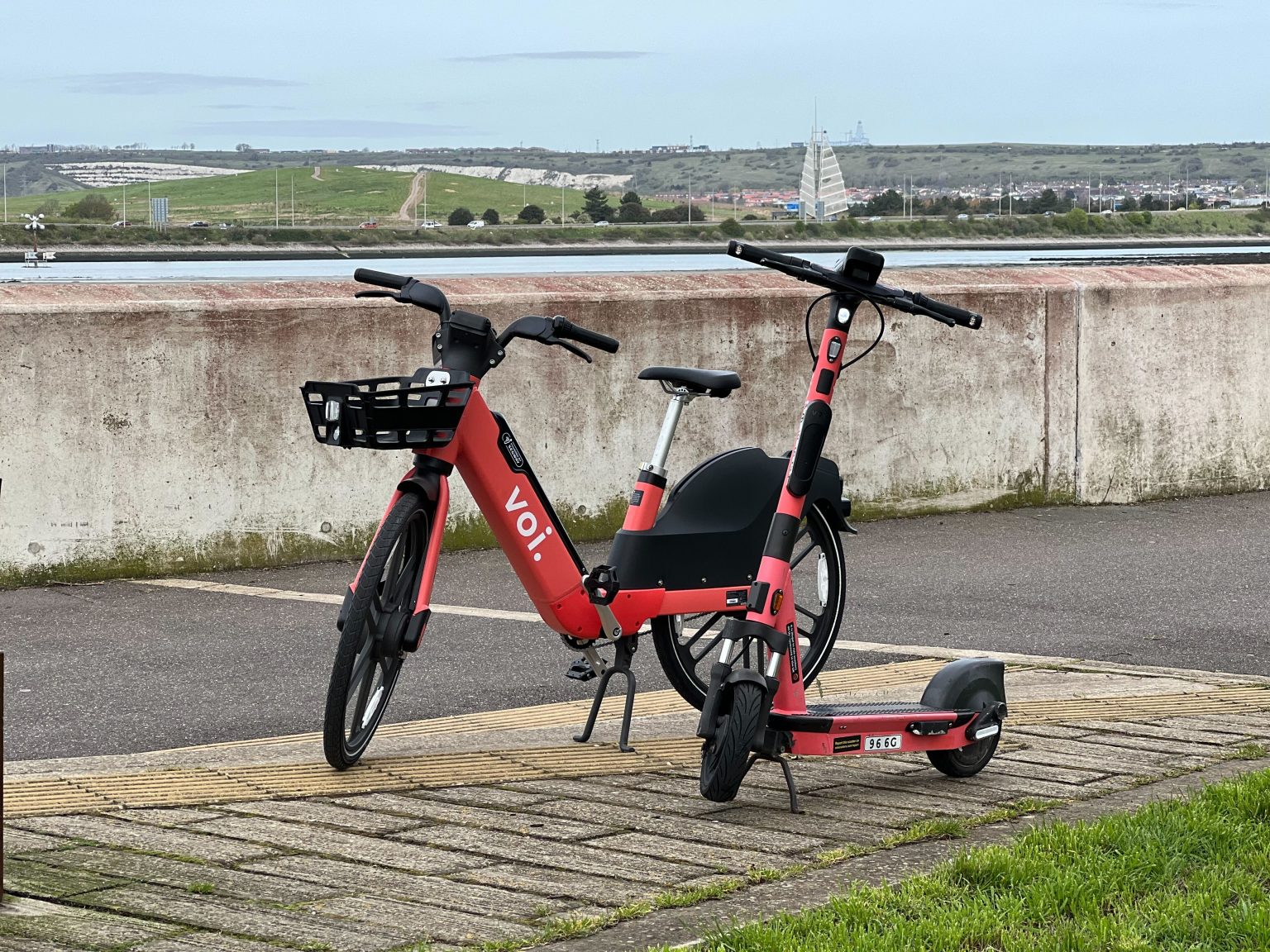
Portsmouth re-enters the bike-share market with market-leading results
Having seen its first bike-share scheme collapse, UK city Portsmouth has become an example of how better vehicles, parking availability, and risk-sharing between operators and municipalities can reignite public-bike use.
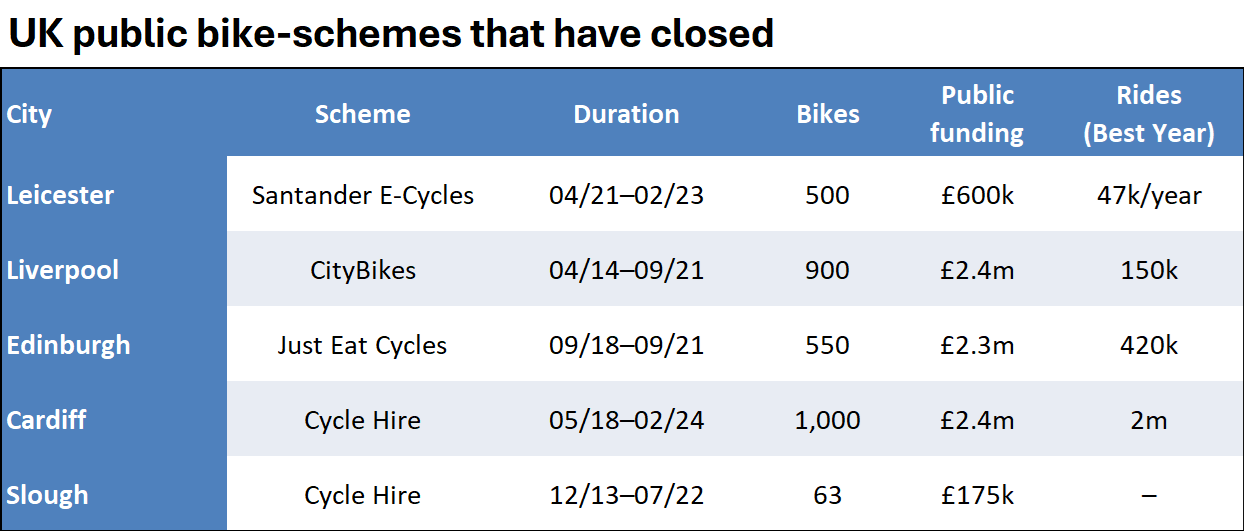
The UK’s experience with bike-share has been mixed. Despite millions in public investment, several schemes have closed in recent years.

Marcus Miller, Senior Market Development Manager, Voi
The challenges faced by previous bike share schemes in the UK include:
- The high levels of public investment and subsidy required to operate schemes.
Some cities were subsidising each ride at a significant cost. For example, Edinburgh was paying around £5–6 per ride, on top of user fees resulting in a higher cost per ride than alternative transport modes (see table below). - Low user uptake, often due to competition from alternative options like e-scooters, made many schemes unsustainable.
“In a lot of cases — Slough, Liverpool — they were running quite successfully, and then an e-scooter provider came in, and quite quickly the scheme became unsustainable,” explains Marcus Miller, Senior Market Development Manager, Voi. - City-specific factors: low cycling rates, high car dependency, and limited cycling infrastructure including parking made it difficult to grow ridership.
These challenges led to several schemes shutting down or failing to achieve sustainability, despite large initial investments and attempts to adapt and often because the city was taking significant financial risk.
Portsmouth was another city that initially had little success with micromobility with the closure of its public bike-share system in 2023.
But having relaunched with an operator-managed scheme, it now stands out as a model of how sharing risk between city and operators can deliver better outcomes for both the city council and its residents.
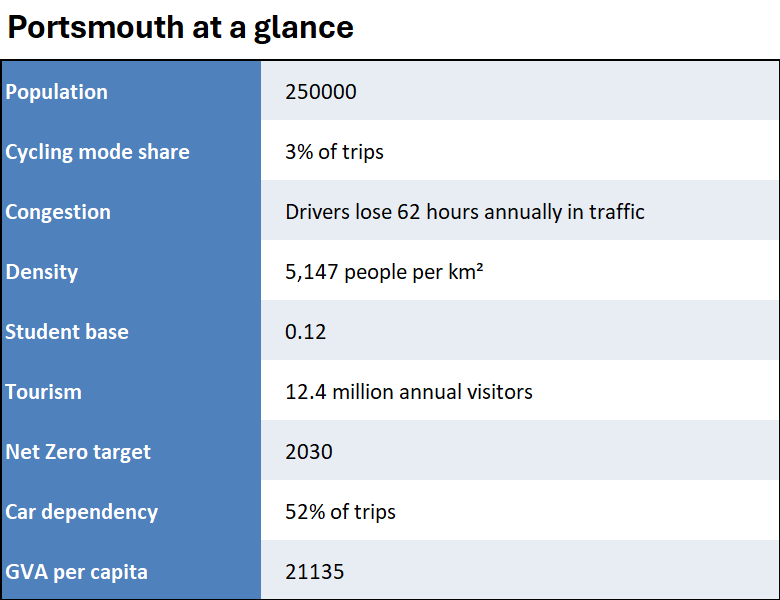
As an island city, Portsmouth offered some natural advantages to bike share in that it is compact, densely populated, and home to large student and tourist populations. But it also offered a challenging environment for cycling: 52% of trips were made by car, there was limited cycle infrastructure, and cycling only had a 3% modal share.
The breakthrough came when the city invited micromobility operator Voi to take over after its publicly funded bike-share failed. The original scheme, with £500,000 invested, had low usage and was quickly discontinued. Voi initially hesitated — until the city offered a subsidy of £300,000 to share the risk.
Portsmouth bounces back
Voi has introduced a free-floating e-bike system to replace the heavy manual vehicles which the docked public system relied on.
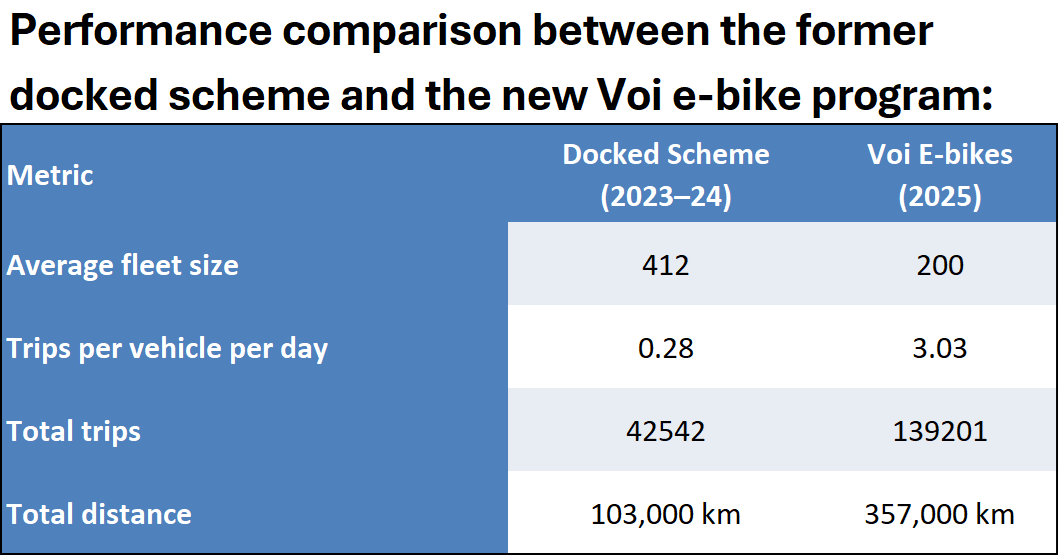
Since launching in early 2024, Portsmouth’s new e-bike fleet has outperformed all expectations:
- 4 trips per vehicle per day, compared to 0.3 for the previous scheme.
- 139,000 rides in nine months, surpassing 42,000 rides achieved over 18 months before.
- E-bikes outperforming e-scooters in trips per vehicle per day
“We’re getting a huge amount more trips per vehicle per day, 12 times what the previous scheme got,” says Marcus Miller. “Our bikes are actually outperforming the scooters in terms of trips per vehicle per day, which is quite an uncommon metric across the industry.”
Trips grew steadily through 2025, peaking at nearly 25,000 monthly rides in August before stabilising in autumn.
According to Miller, the factors that have contributed to Portsmouth’s turnaround include:
- Parking Density: increased from 40 to 200 parking areas.
- Scooter Parity: the bikes have the same app, pricing, and parking zones as scooters.
- Reliable Vehicles: Voi has deployed sturdy electric dual-gear models over the manual bikes used in the first scheme.
- Infrastructure: new routes and cycle lanes have been built.
- Cultural Shift: growing comfort with shared mobility across the UK.
“The parking network density has been really important because if it is uneven between the two different modes [scooters and bikes] you’re going to favour one mode over the other,” comments Miller. “The vehicles have been vital in retaining riders, and also the seed subsidy, you could call it, has basically allowed us to share the risk with the city.”
The subsidy of £300,000 from the local government meant the city and operator were both sharing risk. As a result, the estimated lifetime subsidy per ride is just 15 pence— fifty times more efficient than many legacy UK schemes.
Key takeaways
- E-scooters and bikes need an equal playing field.
- Dense parking networks are crucial to accessibility.
- Reliable, high-quality vehicles retain riders.
- Minimal ‘seed’ subsidy allows operators and authorities to share risk.
- Bikeshare is becoming increasingly dockless and electric.
“Portsmouth has become one of the best-performing cities and I think the conclusion in the UK is that we’re seeing tenders where lots of cities are now interested in dockless shared-bike schemes,” says Miller.
Main photo: Portsmouth City Council / Voi